
Guide — Orange County & Los Angeles County
Garage Door Opens Halfway? Causes and Next Steps
A door that opens halfway and stops has four usual suspects: an up-limit (open travel) set short, a worn or unbalanced spring system, a binding track, or an overheating motor. The first is a settings fix; the other three are hardware — and spring work belongs to a pro.
This guide sorts the four causes into DIY-safe and pro-only, and explains what heat does to Orange County openers.
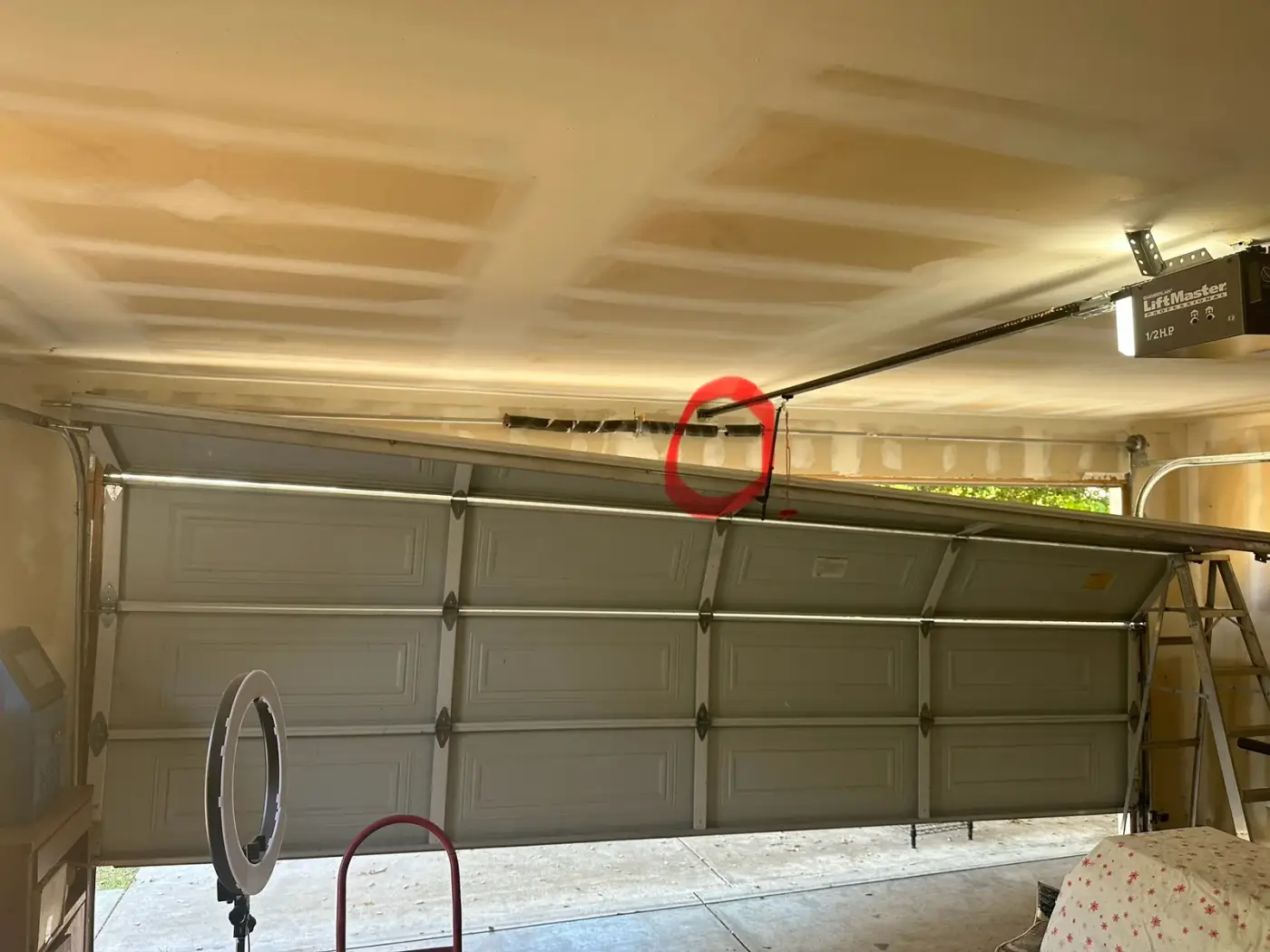
The Four Usual Causes
- Travel limits set short. The opener stops where it’s told to stop. If the halt point never changes and the door moves freely by hand past it, settings are the suspect.
- Spring balance failing. A tired spring can’t carry its share of the weight, and the opener quits mid-lift to protect its motor. The tell: the door feels heavy by hand.
- Track binding. A bent rail, a flat-spotted roller or a loose jamb bracket adds friction until the opener hits its force limit and stops as designed.
- Heat. A motor that stops at inconsistent points, works again after cooling, and fails more on hot afternoons is likely thermal-protecting itself.
A 60-Second Test to Narrow It Down
Before touching any setting, four quick observations sort the causes:
- Does it stop at the same height every time? The same spot points to travel limits; a wandering stop points to springs, track or heat.
- How does it feel by hand? With the door closed, pull the release cord and lift. Smooth and light means the door is fine and the opener or its settings are the story. Heavy means springs.
- When does it fail? Hot afternoons and back-to-back cycles point to a motor protecting itself.
- What does it sound like? A scrape or pop on the way up is the track or rollers talking.
Two minutes of watching beats twenty minutes of adjusting — and it tells a technician exactly where to start.
DIY-Safe vs Pro-Only
One of the four causes is a homeowner fix; the other three involve load, tension or electricity.
| Fix | DIY? | Why |
|---|---|---|
| Adjusting travel limits | Yes, carefully | Screw-adjusted or button-set per the opener manual; small steps, retest each time. |
| Lubricating rollers, hinges and rail | Yes | Garage-door lubricant at the moving points — a ten-minute job covered in our maintenance checklist. |
| Re-tuning force settings | Cautious | Force set too high masks real problems; if you’re unsure, leave it for a tech. |
| Spring adjustment or replacement | No | Stored energy in springs injures people every year — pro tools, pro training. |
| Track trueing, cables, motor diagnosis | No | Bent tracks under tension, fraying cables and electrical faults are shop jobs. |
The Heat Factor
Orange County heat cycles matter more than most guides admit. A motor mounted in a hot garage runs hotter still, and thermal cutoffs trip faster on back-to-back cycles — the pattern shows up in west-facing garages and homes where the door cycles hard on summer afternoons. Openers are built for intermittent duty: a few cycles, then rest. Garage-sale days and moving days are when thermal cutoffs show up for the first time.
If your door quits more in July than in January, heat is a real clue. Shade and ventilation help, shorter duty cycles help, and a pro can verify the motor isn’t straining against an unbalanced door — the combination that cooks openers for good.
When to Call Instead
Heavy by hand, stopping at random heights, or cables looking loose are pro territory: book garage door spring repair for balance problems, garage door opener repair for motors and boards, and the emergency line if a door stops halfway and then slides — a door that moves on its own is a safety stop, not a quirk.
Halfway-Stop FAQs
My door stops at exactly the same spot every time — is that the spring?
Probably not. A fixed halt point usually means travel limits; a spring problem stops the door at varying heights as friction and heat change. The hand-past-the-point test tells them apart.
Can I just raise the force setting so the door finishes?
Not as a fix. Force up masks the real cause — a binding track or failing spring — and strains the parts behind it. Find the cause first.
Why does it work in the morning and fail in the afternoon?
Heat. Motors thermally protect themselves, and a hot garage plus consecutive cycles pushes them over the cutoff. Let it cool; if the pattern repeats, have the door’s balance checked.
Is it safe to leave the door halfway?
Not overnight and not unattended — half-open doors can slide, and the gap invites both weather and people. Secure it and get same-day service.